

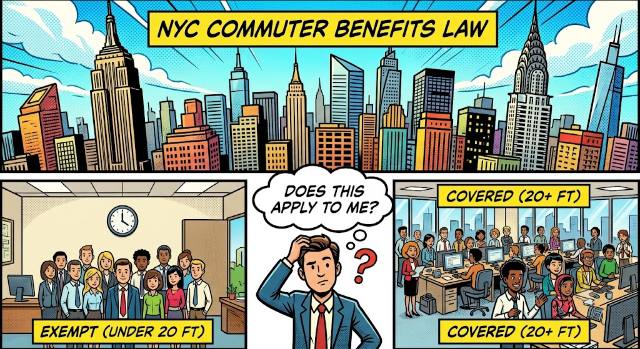
If you have twenty or more full-time, non-union employees working in New York City, you are required to offer them a pre-tax commuter benefit. Most employers who fall foul of this are not refusing to comply. They crossed a threshold they were not counting.
Who it applies to
For-profit and nonprofit employers with twenty or more full-time employees working in the five boroughs — Bronx, Brooklyn, Manhattan, Queens, Staten Island. Full-time means averaging thirty or more hours a week. Part-time employees do not count toward the threshold.
Government employers are exempt, as are workers covered by a collective bargaining agreement — though if you have twenty or more non-CBA staff alongside a union workforce, the obligation applies to them.
The three-month rule
This is the part that catches people. The threshold is measured on a rolling three-month average of full-time headcount, not on a point-in-time count. A company that hires steadily through a quarter can cross twenty without anyone noticing, because no single payroll run looks like a milestone.
Once you cross it, eligible employees must receive a written offer no later than four weeks after they begin full-time work.
And it does not switch off. Once an employer crosses the threshold, the obligation to those already-eligible employees continues indefinitely — even if headcount later drops back below twenty. There is no falling out of scope.
What has to be covered
Pre-tax payroll deductions for qualifying commuting expenses, up to the federal IRS limits:
- MTA subway and local bus
- Regional rail — LIRR, Metro-North, NJ Transit, Amtrak
- Eligible ferries and water taxis
- Commuter vanpools carrying at least six adults
Not covered: parking, bicycle commuting, and rideshare. Uber and Lyft do not qualify, which surprises people every year.
2026 limits
The IRS raised the monthly pre-tax limits for 2026:
| Category | 2026 | 2025 |
|---|---|---|
| Transit and vanpool | $340 / month | $325 / month |
| Qualified parking | $340 / month | $325 / month |
These are separate buckets. An employee who drives to a station and takes the train can shelter up to $680 a month across both.
What it costs you
Nothing, in the sense that matters: there is no required employer contribution. The law obliges you to facilitate pre-tax deductions from the employee’s own wages. You may subsidise it if you want to, and that contribution is deductible.
The actual cost is the third-party administrator fee. Set against that, wages diverted into a pre-tax commuter benefit are not subject to FICA and Medicare — roughly 7.65% — so for a participating workforce of any size the programme frequently pays for itself.
Staying compliant
- Written offer to every eligible full-time employee
- Records of the offer and of each acceptance or declination, kept at least two years
- Offers made within four weeks of an employee reaching full-time status
Keep the declinations. In an enforcement review the question is almost never whether the benefit was good. It is whether the offer was made, and whether you can show it.
Penalties start at $250 and can compound every thirty days. The first violation typically carries a cure period; that grace does not extend to a pattern.
A little history, because it explains the shape
Local Law 53 passed on 20 October 2014, took effect 1 January 2016, and enforcement began on 1 July 2016 after a six-month grace period. The structure was built around subway commuting in a five-day-a-week city. Hybrid schedules have changed participation rates considerably, and have not changed the obligation at all.
If you have people working in the boroughs and you are not certain where your rolling average sits, it is worth a five-minute conversation.
General information for employers, not legal advice. Verify current limits and requirements against the NYC Department of Consumer and Worker Protection and IRS guidance before acting.