

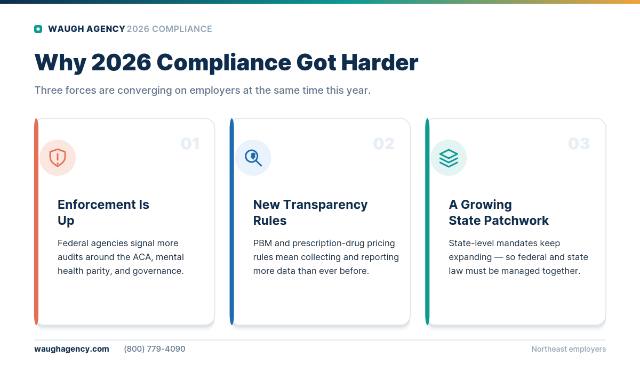
Benefits compliance got harder in 2026, and not because any single rule changed dramatically. Three things moved at once: federal enforcement picked up, prescription drug and PBM transparency requirements landed, and the patchwork of state mandates got wider. Each is manageable. Together they add up to something that no longer survives being handled once a year.
ACA reporting and the employer mandate
An applicable large employer — generally fifty or more full-time equivalents — must offer affordable, minimum-value coverage to full-time staff or face penalties under §4980H.
Two separate reporting obligations follow. Under §6056, ALEs file Forms 1094-C and 1095-C reporting what was offered, to whom, month by month. Under §6055, insurers and self-funded plans report who actually had coverage, on 1094-B and 1095-B, or in Part III of the 1095-C.
The errors we see are almost never a failure to offer coverage. They are wrong codes in Part II of the 1095-C, and late filing. Both produce IRS letters that look alarming and are usually answerable with the underlying records.
ERISA documents and Form 5500
Every group health plan needs a written plan document and a Summary Plan Description furnished to participants. The carrier’s certificate of coverage is not an SPD — it describes the insurance, not the plan, and omits most of what ERISA requires.
Plans with a hundred or more participants at the start of the plan year file Form 5500 annually. Participants means enrolled employees plus COBRA beneficiaries and retirees — not covered lives, which is the count people get wrong in both directions.
A wrap document consolidates medical, dental, vision, life and disability into one plan with one number and one filing, rather than leaving each carrier policy as its own unwritten plan with its own potential 5500.
Section 125
If premiums come out of pay pre-tax, there must be a written cafeteria plan document. Without one, every pre-tax deduction is technically taxable — for every employee, for every year it has been running. The document also governs mid-year election changes, and it requires annual nondiscrimination testing.
Failure here is not a penalty in the usual sense. It is a tax consequence falling personally on highly compensated employees, which makes it a conversation with the owners rather than with HR.
COBRA
Twenty or more employees and continuation coverage must be offered on a qualifying event. The deadlines are short and asymmetric — you have thirty days to notify the plan administrator, the administrator has fourteen to send the election notice, and the qualified beneficiary has sixty days to elect and forty-five more to pay.
Read those last two together and coverage can be reinstated retroactively more than three months after termination, with every claim in the interval payable. On a self-funded plan that is your money.
Mental health parity
The Mental Health Parity and Addiction Equity Act requires that mental health and substance use benefits not be more restricted than medical and surgical benefits. Regulators are increasingly asking for the NQTL comparative analysis — documentation showing that non-quantitative treatment limitations were applied comparably in writing and in operation.
This is the obligation most employers have never heard of and cannot produce on request. Ask your carrier or TPA for their analysis before somebody else asks you for it.
RxDC reporting
The Prescription Drug Data Collection report requires plans to submit prescription drug and healthcare spending data, typically by 1 June. It requires coordination between the carrier, the PBM and the administrator, which means it fails when nobody is clearly the owner of it. Decide who is.
The Massachusetts layer
PFML. Employer contributions, employee deductions, workplace notices, and rate updates that change periodically and must be reflected in payroll. Private plan exemptions are available and are applied for on the state’s own quarterly schedule.
Minimum creditable coverage. Massachusetts maintains its own MCC standards, which interact with what you offer and with what employees report on their state return.
And if you employ anyone outside Massachusetts, add their state’s programme to the list. One remote hire puts you inside a new state’s regime.
The point
Compliance is not an annual scramble. It is a calendar with owners against each line. The employers who find this hard are the ones treating it as a project. The ones who find it routine set it up once as a system and then maintain it.
Ask us to review what exists — a documents-and-filings audit takes about a week and there is no charge for it.
General information for employers, not legal or tax advice. Thresholds, deadlines and penalty amounts are indexed or amended periodically; confirm current figures before relying on them.