

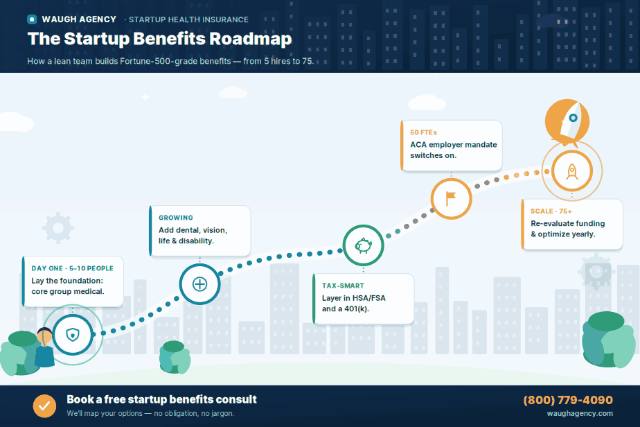
Most founders come to this question late, and ask it backwards. The question is not “what can we afford to offer”. It is “what will we be required to offer, when, and what does it take to be ready”.
Three reasons it arrives earlier than expected
Hiring. Past roughly ten people you stop competing with other startups for talent and start competing with companies that have a benefits page. Coverage is not a perk at that point; its absence is a question you have to answer in every final-round conversation.
Retention. Replacing an employee costs a serious fraction of their salary. The people most likely to leave over benefits are the ones with families, who are also usually the ones you least want to lose.
Compliance. This is the one that catches people, because it is automatic. At fifty full-time equivalents the ACA employer mandate applies and you must offer affordable, minimum-value coverage or face penalties. At twenty employees COBRA applies. At a hundred plan participants Form 5500 applies. Nobody writes to tell you.
And the ALE test looks backwards — at the prior calendar year. The year you grow past fifty you are not yet an ALE. The following year you are, whether or not anybody noticed.
The building blocks
Medical
The foundation, and the bulk of the cost. Most companies at this stage cover somewhere between fifty and eighty percent of the employee-only premium. What you do about dependent coverage is a separate decision and a much larger number.
Dental and vision
Inexpensive, and disproportionately noticed. Employees who never think about their medical plan have an opinion about whether their dentist is in network.
Life and disability
Group term life and short- and long-term disability. Cheap, rarely discussed, and the thing that matters most on the day it matters at all. Watch the guaranteed issue limit on life — above it employees must answer health questions, and most never get round to it.
HSA and FSA
A qualified high-deductible plan paired with an employer HSA contribution frequently costs less in total than the richer plan it replaces, and leaves the employee ahead. It is the most under-used move available to a company this size.
Retirement
A 401(k), with or without a match, is close to an expectation at a venture-backed company. Several states now also mandate a retirement offering above a headcount threshold, so this may not stay optional.
Voluntary lines
Accident, critical illness, hospital indemnity, pet. Employee-paid, so they cost you nothing but administration — which is the reason to pick two or three rather than offer all of them.
How to fund it
Fully insured. Fixed monthly rate, carrier holds the risk. Simple, and a good year produces no refund.
Level-funded. Fixed monthly payment into a claims account, stop-loss above it, refund at year end if claims run low. Budgeting predictability with upside, and monthly claims data you can actually read.
Self-funded. You pay claims, stop-loss caps the exposure. Most control, most variability, most work.
For a company of five to seventy-five, the honest answer is nearly always fully insured or level-funded. Level-funded programmes now exist for groups well under twenty-five lives, which was not true a few years ago — so it is worth having modelled rather than assumed away.
Set the administration up once
The mistake is running the first two years on spreadsheets and email, then trying to reconstruct a census at renewal. Get enrolment, eligibility rules, carrier feeds and payroll deductions into a benefits platform from the first open enrolment. It is the same work either way; doing it in order costs less.
We configure and maintain Employee Navigator for our clients rather than charging for it separately.
Tell us your headcount and where people live and we will tell you what applies to you and what is coming.
General information for employers, not legal or tax advice.