

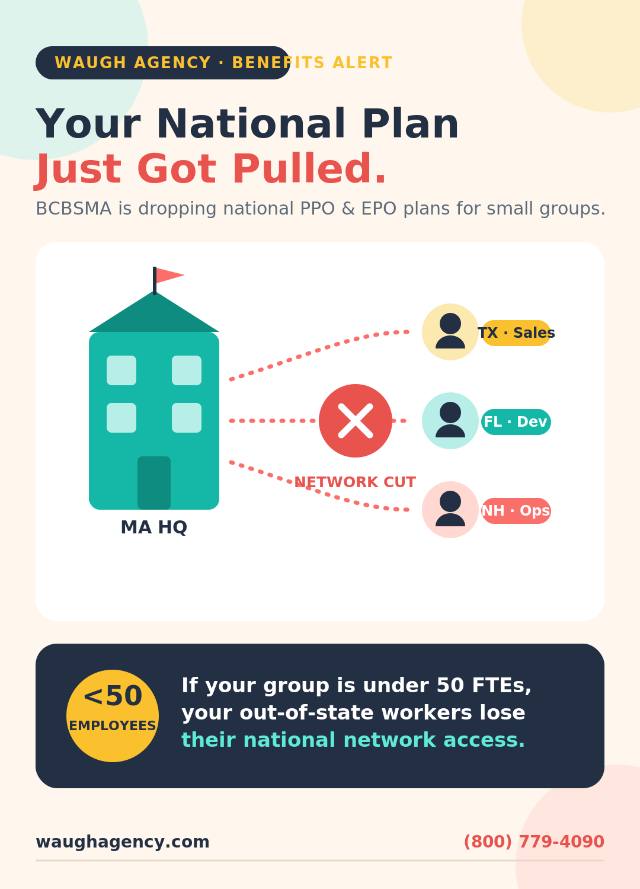
Blue Cross Blue Shield of Massachusetts will no longer offer national PPO or EPO plans to groups with fewer than fifty full-time equivalent employees, effective with 2027 renewals. If your whole workforce is inside Massachusetts, this is a footnote. If it is not, it is the most consequential thing on your renewal.
The specific problem
Picture a Boston company with forty people. Twenty-two in Massachusetts, six in Texas, five in Florida, the rest scattered across the Northeast. That company has been buying a national PPO because it is the only sensible way to give a developer in Austin the same coverage as an account manager in Somerville.
From 2027, that product is not available to them. The Massachusetts local network options that remain are excellent — inside Massachusetts. For the person in Austin they are close to worthless, because the nearest in-network provider is a thousand miles away.
This is not a pricing problem. It is an access problem, and you cannot solve an access problem by shopping harder in the same market.
PPO and EPO, briefly
A PPO gives a broad network and lets members go out of network at higher cost. An EPO is network-based with no out-of-network coverage except emergencies. Both have been the default answer for multi-state employers, and both are what is being withdrawn at the small-group end.
Why the answer is usually funding, not networks
Once a fully insured carrier will not sell you national access, the practical route to it is a self-funded or level-funded arrangement — because in that structure you are not buying a carrier’s packaged product. You are buying claims administration and network access separately, and the administrators serving that market do offer nationwide PPO and EPO networks to groups well under fifty lives.
That is the mechanical reason this carrier decision pushes employers toward self-funding. It is not that self-funding suddenly became cheaper in June. It is that the fully insured product they were relying on stopped existing.
What you also get, having gone there
Three things worth knowing about, because they are genuinely not available on a small-group fully insured plan:
Pharmacy carve-out
Separating the drug benefit from the medical plan lets it be negotiated and audited on its own terms. On a plan where pharmacy is a third of spend, being able to see and question that line is worth more than most plan design changes.
International sourcing for specialty drugs
Some self-funded programmes source high-cost specialty and brand medications from regulated markets abroad, where the same drug carries a very different price. It is not for every plan and it needs care, but the arithmetic on a single specialty claimant can be substantial.
Networks that actually cross state lines
The thing that started this. National PPO and EPO access for a group of forty, which the fully insured market has just stopped offering.
Who should be doing something about this now
- Groups under fifty FTEs on a BCBSMA national PPO or EPO
- Anyone with remote or multi-state employees, whatever carrier
- Companies scaling quickly enough that “we’re all in Boston” stopped being true recently
- Employers without dedicated HR, who will find out about this at renewal otherwise
Timing
2027 renewals. Which sounds distant and is not, because a self-funded or level-funded arrangement requires health questionnaires, stop-loss underwriting and quotes — and that process wants to start roughly a hundred and twenty days before the renewal date, not thirty.
If your renewal is in January, you are already inside the window where the work should be starting.
How self-funding actually works, or send us your census and renewal and we will model it against what you have.
General information for employers, not insurance advice. Carrier product decisions and effective dates should be confirmed directly with BCBSMA or your broker.