

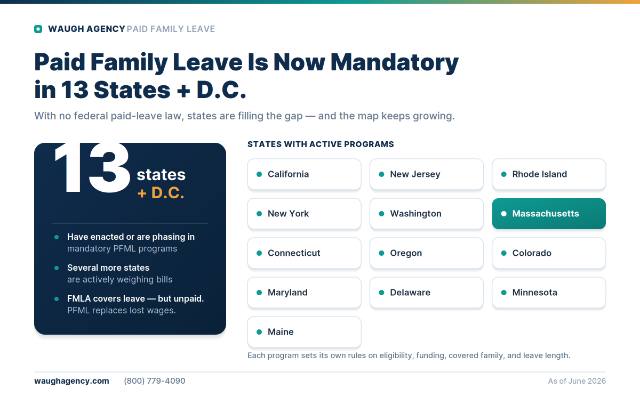
There is no federal paid family leave. FMLA gives up to twelve weeks of job-protected leave and pays nothing. States have filled the gap one at a time, and the result is a patchwork that a multi-state employer joins by accident.
Where programmes exist
Thirteen states plus the District of Columbia now operate or are phasing in a paid family and medical leave programme: California, New Jersey, Rhode Island, New York, Washington, Massachusetts, Connecticut, Oregon, Colorado, Maryland, Delaware, Minnesota and Maine.
Each has its own eligibility rules, contribution split, wage base, benefit duration, definition of a covered family member, and notice requirements. Very little transfers from one to the next, which is precisely what makes this expensive to handle casually.
The rule that catches employers
Paid leave is generally owed where the employee works, not where the employer is registered. Hiring one person in Colorado brings a Massachusetts company inside Colorado’s programme — registration, payroll contributions, employee notices, and a claims process running through the state rather than through your carrier.
Nobody sends a letter about this. It arrives when the employee applies for leave.
What qualifies
- Your own serious health condition — surgery, chronic illness, mental health
- Caring for a family member with a serious condition. The definition keeps widening: several states now include grandparents, siblings, domestic partners, and in some cases chosen family
- Bonding with a new child — birth, adoption or foster placement
Who pays
It varies, and you cannot assume. Some states fund entirely through employee payroll deduction — New Jersey, for instance. Others split employer and employee, as Massachusetts and Washington do. A few place the whole cost on the employer.
Most states allow a private plan exemption: your own plan, at least as generous as the state’s in every respect and costing the employee no more. Where the arithmetic works it is usually the better answer, because claims run through a carrier that answers the phone instead of a state portal. Exemptions are applied for on the state’s schedule, typically quarterly and before the quarter begins — and they are not automatic at renewal. Letting one lapse means owing contributions back to the start of the quarter.
Where the real money is lost
Not in penalties. In paying twice.
Short-term disability
STD overlaps heavily with the medical-leave half of a state programme. Some states let you integrate the two so the employee receives a combined benefit up to a wage percentage. Others do not. Left uncoordinated, you have bought the same weeks from two places.
FMLA
Runs concurrently with state paid leave in most designs — but only if your policy says so. If it does not, an employee can take state paid leave and then twelve weeks of FMLA after it.
PTO
Some states let you require concurrent use of PTO. Others prohibit it. This is a state-by-state policy review, not a single decision.
Health coverage during leave
FMLA requires you to maintain health coverage during leave. Many state programmes impose similar or broader continuation obligations, and some extend beyond what FMLA covers. Check the state, not the federal floor.
What to do
Keep a list by state of where your employees actually live. Register where registration is required. Decide, in writing and before the first claim, what stacks and what offsets. Then tell people how it works — the confusion around these programmes falls hardest on employees who need them at the worst possible moment.
How we handle multistate leave, or send us your state list.
General information for employers, not legal advice. State programmes change frequently; confirm current rules with the administering agency.